Showing posts with label people. Show all posts

Tuesday, April 21, 2015

Architect Carlos Arnaiz of CAZA: The Philosophy of Design


File:18 Capilla CCV.jpg

While others look at buildings as their creative visions made real, the charming and bookish architect Carlos Arnaiz – winner of two consecutive Progressive Architecture awards in 2008 and 2009 and the
AIANY building merit award in 2008 – looks at the landscape with a spatial view in mind.


Talking like an engrossed history teacher and looking more like an inspiring professor of Law
rather than your typical architect, 35-year-old Filipino-Colombian architect Carlos Arnaiz of
the Brooklyn-based architectural firm CAZA admits he came into architecture through a very
unusual route. While most architects he knew were artists and had explored their creative side
at a very early age, he on the other hand, was a Philosophy major who hadn’t even the slightest
skill at doodling.

“There’s a branch in philosophy that I got interested in (while in Williams College) called geography. It’s not like the geography we know where you have to know the capital of Afghanistan,” says this self-proclaimed geek. “The branch of philosophy (that I studied) is a discipline that emphasizes
space and spatiality as a way of finding solutions to complex problems.” Carlos likens the discipline to the centuries-old Chinese tradition of feng shui – but without the kooky mysticism. “There’s a whole Chinese tradition of thinking about the importance of space — the economics of space, how we live in space, how we hang things, whether we paint walls this way. (If you may notice) just the organization of your living room space has this emotional, mental and psychological impact on how you live. The fact that there’s such a long tradition is a testament to how space can impact us on a
personal human level. When you zoom out to the macro level, the way you organize and use space
on a wider plane will also have a big impact on the people.”

Though he found geography and philosophy intellectually satisfying (he graduated magna cum laude), he felt frustrated that all his ideas had no real tangibility. ”I was operating on  theoretical level. I was hungry for a tool, an instrument to make my ideas real in the world. And that’s how I stumbled into architecture. Architecture has an intellectual side to it, but it also has a very practical side to it. It has givens like materials, paint, wood, concrete, steel and glass.”

Excited by his newfound calling and direction, Carlos applied for a master’s degree at Harvard University’s Graduate School of Design where he met the Dean of the College of Design, Peter Rowe. Together, they collaborated on a number of consulting projects for the city of Barcelona and the Emilia-Romagna Region in Italy. There they were hired by both regions’ respective governments to develop a regional master plan to solve the city’s problems. In 2008, Carlos received the Wheelwright Prize from Harvard University for his work on the Urbanism of the Modern University in four Latin American cities: Mexico, Caracas, Bogotá and Sao Paolo.

After a short stint with several other architects and architecture firms like Office DA, Ruf, Field Operations and Stan Allen Architect in New York, Carlos established his own firm CAZA and has since been traveling the world, working on projects in the Philippines, Colombia, Costa Rica and Taiwan. He recently finished building a chapel, his gift to the Chosen Children Village (a foundation in Silang, Cavite) for physically and mentally challenged children.

File:10 Capilla CCV.jpg

“It’s a wonderful story,” shares Carlos. “In 1989, a couple – a Filipina (Maria Angeles ‘Lita’ Peypoch Fullerton) and her American husband – decided to adopt a child with a disability. They instantly fell in love with the child and so they adopted another one, and then another, and then the next thing
they knew they had 200 kids and had to get the house next door. It’s a whole community called the Chosen Children Village and we designed a very simple chapel for their growing family,” Carlos
beams proudly as he himself is a very proud father of two little boys – Lucas (three) and Tomas (six months) with wife Elizabeth Taylor (no relation to the iconic diva).

The chapel, built from humble concrete, is a breathtaking sight with ceilings that rise to a heavenly height. Playing with verticality and sunlight, Carlos used the concrete to shape columns and panels
that allowed natural ventilation and different lights to illumine the sacred space. “There’s skylight up above. There’s light coming through these little panels here. So when you’re inside, you’ll see
that there’s a real play of shadows and a filtering effect of light from all angles — diffuse light, accent light and direct light,” Carlos beams as he animatedly paints a picture of his chapel with his hands.

He would later win a Merit Award from the American Institute of Architects and Faith & Form Award for this particular project. One of his other most prized works was the widely acclaimed
High Line project in New York, which he worked on as designer and senior associate. And like the Chosen Children Village, he loved the project because it celebrated a great history.

In the 1920s, elevated steel railroad tracks were built in Manhattan to transport cargo from the northern tip of the New York borough to its southern tip. Thereafter, in the early 1960s the tracks were abandoned and left to rust, causing people to insist that it be torn down by the city because it was an eyesore. However, the clamor to save the community marker, headed by locals and celebrities like Meryl Streep and Robert de Niro who lived in the Tribeca area, led to the idea of rehabilitating the ruins… and thus the High Line design competition was born.

In 2002, Carlos, with a team of five, bested 30 other firms with their thoughtful design. “Basically, what it is is a park. It sounds simple but it’s spectacular when you go up there. You take these stairs and imagine you’re like flying up in the sky almost 30 feet above the street. You can see the water, you can see the mountains, you can see midtown, and you can see the high rises of Manhattan. Here families can have picnics; people sunbathe and watch the sunsets. It’s magnificent.” Not only was Carlos able to do an impressive revamp of the old railroad, he was also able to preserve a piece of the
community that could have been easily lost to history.

The aerial greenway crosses 20th Street in New York

Railway tracks with the walking path cross 20th Street

Though his style may not be obvious in all of his projects, rest assured that each project is meticulously planned and imprinted with Carlos’ thoughtful touch. “I always say that designing a home for someone is like tailoring a suit. It has to be perfectly made; fit to the shoulders and to the waist; and to the way the person moves. In order to build him a home, you really have to study that person’s life.”

In making a home, accommodating the client’s lifestyle is more important than the architect’s “vision” he says, contrary to the myth presented in Ayn Rand’s The Fountainhead. “In the novel, one
genius (Howard Roark) supposedly comes up with this concept that solves everything. The fact of the matter is, it’s not true. I say the myth is damaging because I think a lot of young architects study architecture with that dream and they kind of get disillusioned when they realize that architecture is
complicated. It involves a lot of negotiations. Not one idea ever solves everything and we should be humble enough to accept that good ideas can come from anyone on the team.

“And I think as creative people, we are constantly cannibalizing ideas from others. I think it’s impossible to be completely original. You’re always borrowing and quoting, acting and reacting whether you like something or not; even not liking something forces you to take a position.” Though Carlos may not believe in originality, he however believes in true collaboration. “I don’t mind having too many cooks. I’m flexible and I encourage feedback. I believe the perfect project would be when
architects, clients and engineers come together.”

Having said that, Carlos belts a hearty laugh, admitting that he doesn’t know how smoothly that
will work out when he’s to build his own dream house. “I think it would be a nightmare! It would
be the ultimate dream and it would be a true collaboration because my wife is also an architect.
But we would never finish. It would be a perpetual project. And I have no idea how it would look like. ”

But even if he did have a blueprint in mind, Carlos for now would not have the time to build it as this busy bee is currently developing a student center for the National Chiao Tung University in Taiwan, a house in Costa Rica, a master plan for a coastal resort in the Philippines together with the construction of a prototype house, a cluster of three high-rise housing condominiums in Manila and a new market for vegetable farmers outside Bogota, Colombia. He also manages to squeeze in time to teach a class called “Urban Design Theory” at Pratt Institute.

For Carlos, architecture is not merely adding another building to the already overcrowded landscape. Rather, it is a discipline of design. He studies every aspect of the project, figuring in the sentiments of his clients, studying how to respond to the history of the location and above all, planning how his space will beautifully and seamlessly fit in the whole scheme of the city.


Marina Cruz: Art & Soul


For award-winning visual artist and child adoption advocate Marina Cruz, the unearthing of her mother’s baptismal dress made her reflect on the meaning of having a family. Her reflections gave birth to her own deeply personal art.
It all started in 2001 while Marina, then a second year college student, was rummaging through her mother’s belongings and chanced upon her mother’s baptismal dress. “Imagining my mother as a child seemed so surreal. The dress made me ‘experience’ the childhood she once had. It gave me goose bumps,” shares the cum laude graduate from the University of the Philippines-College of Fine Arts.
It was a poignant moment for her because at the time of the discovery, her mother, Elisa, a primary public school teacher in Bulacan, was often sick. “The tattered dress simulated also my mother’s aging. I felt that I needed to preserve that memory. I realized the value of time, the value of life. You really have to savor every moment with your loved ones because you can never go back.” Since 2001, her art — from the embroidered mementos and mixed-media paintings to her famous “fossilized” baby doll dresses — has followed that same thread of nostalgia and appreciation for family.
In the past decade, Marina has held 14 solo exhibitions in the Philippines, Taiwan, China, Australia and Singapore and has garnered praise from prestigious art groups including the Philippine Art Awards where she won grand prize in 2007. She’s also the recipient of the Ateneo Art Award in 2008, which included a fellowship at La Trobe University’s Visual Art Center, Australia. Later that year, she was awarded with the Freeman Fellowship at Vermont Studio Center, Vermont.
Over time, and through much reflection, the concept and definition of family grew to be an essential part of Marina’s art. As a happily married woman, she hoped that she and her husband, fellow artist Rodel Tapaya, would be able to start their own brood soon. But unfortunately, the couple had difficulty conceiving due to Marina’s polycystic ovary syndrome.
“As artists, our creativity comes natural to us. But when it came to procreation, creating a child, starting a family, it wasn’t as easy,” Marina shares during her TEDx talk at her alma mater, University of the Philippines-Diliman. But like a true artist, she was open to God’s inspiration and creativity.

With her husband’s urging, they decided to adopt. And two months after submitting their requirements to the Department of Social Welfare and Development, the couple was matched with an 11-month-old baby boy, whom they named Yohan, meaning “Gift of God.”
With a precocious toddler now in their life, their world was turned upside down, so much so that Marina did not notice that she was pregnant a month later with Keon.
“People expected me to have twins; my mother had a twin. They were right,” she chuckles. “Just not biological.” Today, as an advocate of domestic adoption, Marina travels the country sharing her own story, and her art helps in spreading her message. “This is very fulfilling for me, to be able to share my art and advocacy, because I was able to discover a new, beautiful way to form families. Family is not defined by biology alone, but love.”

First published in The Philippine STAR, Allure Section
Photography by RITA MARIE ABIOG • Creative direction by LUIS ESPIRITU JR. • Styling by DIANE LASAM • Makeup by SARI CAMPOS • Hairstyling by RHOY CERVANTES • Jewelry by MILADAY JEWELS • Shot on location at  SOLAIRE RESORT & CASINO’s YAKUMI

Sunday, March 29, 2015

Watsons Switch & Save: Enjoy more by spending less

Thanks to generations of wise mothers, Filipinos have been raised to become smart, practical shoppers, always in pursuit of the better deal, the bigger discount, the best value. When it comes to following a budget at home, while it is common for many to scrimp on luxuries like eating out and shopping, personal essentials like toiletries, medicine and vitamins should never suffer from the budget cuts.

In order to be a successful budget-saver, heartthrob crooner and new Watsons ambassador Christian Bautista believes that one should recognize the value of true savings. 
There is a clear difference, he insists, between being frugal and being cheap, and a difference between saving and scrimping. While scrimping is getting by (uncomfortably, at that) with barely enough, smart saving is about choosing the better value, getting the most by spending less.
“(In my own definition and understanding), saving is preparing for the future. It is sacrificing just a little bit so that you and your children can enjoy in the future. Scrimping, on the other hand, denotes something more negative. It is an attitude that’s based on fear. I prefer to save so that I can enjoy,” he adds. 
As the new ambassador of Watsons Switch and Save campaign (he joins other ambassadors Tessa Prieto-Valdes, Patty Laurel-Filart and Iya Villania-Arellano), Bautista believes in the commitment of Watsons to make quality products more accessible to the Filipino consumer.
“You shouldn’t feel that you have to spend an arm and a leg for your personal essentials,” he says. “As an artist, I stock up on mouthwash, toothpaste, charcoal toothbrushes and breath strips and other things since I sing. Watsons offers all of these. And these are not just any cheap alternative, they are good quality that can match what’s in the market. Maganda at mas mura (It’s good and cheaper),” he reveals, adding that he’d rather save on toiletries so that he can splurge on his other passion, which is travelling. For his next trip, he hopes to walk the streets of his favorite city again, London. With Watsons, he knows he’ll be one step closer to achieving that dream vacation.
Lifestyle Feature ( Article MRec ), pagematch: 1, sectionmatch:
In fact, by switching to the Watsons Label products, like Bautista, smart shoppers can get anywhere from 30 percent to 80 percent savings. By bringing down prices, Watsons allows consumers to stretch their purchasing power so they can spend more on their other needs, wants and luxuries like a new phone or car, or a much-deserved vacation.

 Branded vs. Generic
Karen Fabres, Watsons senior manager for marketing, recognizes the hesitance of some Filipinos towards buying generic brands. “There’s the misconception that generic brands are inferior, but abroad, especially in the US, the majority buys generics. Unfortunately, in the Philippines, only a small percent do, so they’re missing out on a lot of savings,” she shares.
“Watsons is able to provide them at more affordable prices because we use formulations that are off-patent and which have already been proven effective. When launching new medicine, innovator brands have to raise prices to ensure ROI to cover the expenses of their marketing, research and such. This is not the same situation for generics, which have already been proven and tested safe,” she adds.
“A lot of our customers take maintenance meds. But according to some studies, the average Filipino consumes only around 50 to 70 medicines in a year, where it should be 365 (one for each day). The reason they don’t take their proper dosage is because their budget is limited. Imagine, if they switched to generics, they can save money and be able to take their medicines accordingly, allowing them to live a more fulfilling, quality life,” shares Victoria Encarnacion, marketing director for Watsons Personal Care.  
Despite being a bit wary of generic medicines, Filipinos are still very smart shoppers, with specific wants and standards from their products. Today, they are more discerning when it comes to shopping admits Encarnacion. “They no longer want just generic soaps and lotions; they look for anti-bacterial, moisturizing, whitening, etc. They look for variant products that provide more function.” To address the growing demands of the evolving market, Watsons has diversified and come out with new variants to their current list of products, delighting budget savers everywhere.
Another trend that Encarnacion is seeing is the fact that consumers are gearing towards a more active lifestyle, with Filipinos placing more importance on their health and taking vitamins even before they get sick.
Actress, singer and aspiring athlete Iya Villania is one of those who look to Watsons for help, to support and sustain her new healthy living. “I’ve been a Watsons girl for two years. Prior to becoming an ambassador, suki na ako. I buy a lot of its tissue, makeup stuff, and especially Watsons Foot Ease gel cushions.” With the savings she enjoys, she is able to allot more to her other activities and indulgences like training for marathons, shoe shopping, eating out, and travelling with her husband Drew.
“I’m really not that big of a spender. While others would invest in designer bags, I prefer backpacks.Nakakahiya nga kasi parang ako lang yung actress na hindi nagdedesigner bag. And when it comes to travelling, I won’t travel Business Class. Don’t judge if I’m in Economy!” shares the radiant beauty.
Iya and Christian are only two of the many Watson shoppers who have learned to switch and save for better deals. Even if they’re successful and they have the means to buy the best and the most expensive personal care products in the market, they think about their purchases and know the importance of saving up for what matters most.
Christian puts aptly into words what Watsons and many budget-savers believe and strive for: “Life is short. Balance your life in both work and play. Save and enjoy.” Indeed, with Watsons, you can spend less to enjoy more.

Tuesday, January 27, 2015

Heart Evangelista: Ready for her Closeup

A mere two weeks away from her wedding day, it's not hard to imagine that there are a million and one things that are going on in Heart Evangelista's mind. Wedding preparations. Honeymoon planning. Family reunions. (Eep! She admits that she hopes to see her mother and father (reportedly still a bit disappointed with the engagement) at the church and reception.) But during the Closeup Diamond Attraction launch at the art-deco inspired Blackbird restaurant, she looked nothing less but calm, cool and confident.

With a dazzling smile that can easily launch a thousand ships, Heart proudly shares her newest role in the Closeup family as its ambassador for Closeup Diamond Attraction, one of the 2015 best beauty picks that promises brilliant pearly whites in an instant. (She first joined the Closeup family 11 years ago when she teamed up with TV heartthrob John Prats.)


"I'm so glad to have Closeup Diamond Attraction in my beauty arsenal, because it highlights my smile. Nothing compliments your overall look better than a dazzling white smile, because it gives you that boost of confidence and it completes your total look," she shares with host Teresa Herrera. "A smile is your best accessory!" she exclaims as she turns to her groom Sen. Chiz Escudero, who nods in agreement.

Closeup Diamond Attraction is available in all leading supermarkets
Inspired by the latest technologies in cosmetic dentistry, the toothpaste formula works by utilizing Blue Light Technology, which is activated through a blue covarine foam, that neutralizes the yellow tones on teeth, instantly making teeth look whiter and brighter," shares renowned cosmetic dentist Dr. Cecile Infantado.

She adds:" And unlike other whitening treatments available in the market (a trip to the dentist for this particular treatment can cost anywhere from P15,000 to P25,0000), Closeup's Diamond Attraction is easy on the pocket and is safe for everyday use. And added benefit, there's no annoying teeth sensitivity (pangingilo) that usually comes with the typical whitening treatments."


Tips for a fresh, radiant look
By celebrity makeup artist Xeng Xulueta

1. To instantly transform accentuate your eyes, create the perfect brow with K-Palette's Real Lasting Eyebrow Liner. Strong brows add structure and easily removes years from your face.
2. Brighten your pearly whites with a quick brush using Closeup's Diamond attraction.
3. To make your smile even brighter, add a dash of ruby on your pout. Darker shades like pantone's color of the year, Marsala, or NARS 'velvet matte lip pencil in Dragon Girl will instantly make your smile pop out.


Wednesday, August 13, 2014

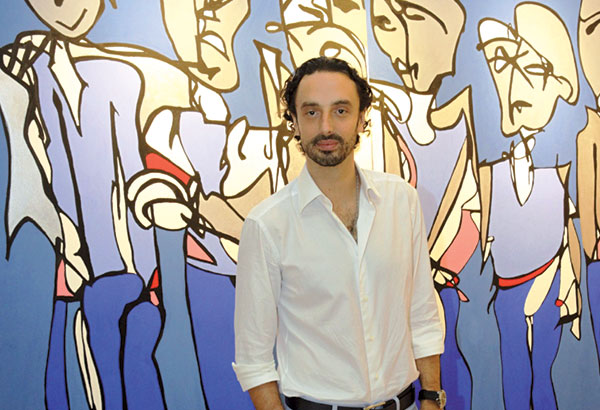
Alexander Charriol: Human Flow IV


French-American artist Alexander Charriol’s work may be “autobiographical, but it is overwhelmingly universal–a visual poem that tackles the entangled nature of who we are.”

From the somber silhouettes that huddle together in the Tin Man Party to the prying eyes that gloss over the provocative woman in Stop the Madness, the figures in each of Charriol’s canvases tell the many stories of the human experience: love, loneliness, selfishness, greed, discontent, as well as the need for human connectedness.

Tin Man Party

Charriol’s creative journey began in 2010 when the graduate of Parsons School of Design decided to move from New York to settle, almost like a hermit, in the hills of Los Angeles. There, in isolation, he picked up the brush and started painting. “I was very lonely, I lost my friends, I lost everything,” reveals the 34-year-old, who admits to also having fallen weak to drug abuse at that time, thus the self-imposed isolation. “I was in a house with a beautiful view but no one around, so I got very lonely and then so I started painting a lot of people.”

With every stroke and brandish of color, Charriol allowed the “flow of feeling and energy” to grow stronger and fill the space that had been left empty. The therapeutic exercise turned into a creative one, and eventually led to an epiphany: “Humans need touch. People need to be together. Without touch, without being together, humans are not gonna survive,” explains Charriol.

STOP THE MADNESS
Stop the Madness

This Human Flow concept permeated his work and persisted well into the creation of his fourth installment in the series, which was exhibited recently at the Altro Mondo Arte Contemporanea, Greenbelt 5, Makati City. 

Excited for the newest collection, admirers and fellow artists like National Artist Arturo Luz, Betsy Westendorp, glass sculptor Ramon Orlina, former CCP president Nestor Jardin, Ballet Philippines president Margie Moran Floriendo and Lane Moving’s Virginia Lane dropped by to show support for their artist-friend.


“Painting can be therapeutic at times when things are going great,” says Charriol. “But once when you don’t know where you’re heading, anxiety starts to fill yourself. No one’s telling you what to draw, what to do, so you really have to stay focused and believe in what you’re doing,” he reveals, adding that when his motivation is lagging, he retreats to his studios in New York and Bangkok. (Especially in Bangkok, where his studio nestles on the bank of the river, Charriol finds that he never runs out of inspiration.) 

Looking around the well-curated space of Altro Mondo, with the massive canvases embracing entire walls, Charriol beams proudly at his work. “It’s good to hear honest feedback. It’s a good feeling to get your art work out of the studio and onto the walls.” And perhaps also, he has realized it’s good to allow others to see themselves in the pictures. We are, after all, connected. His story is their story.


Tuesday, June 18, 2013

Daniel dela Cruz: Doorway to Decision


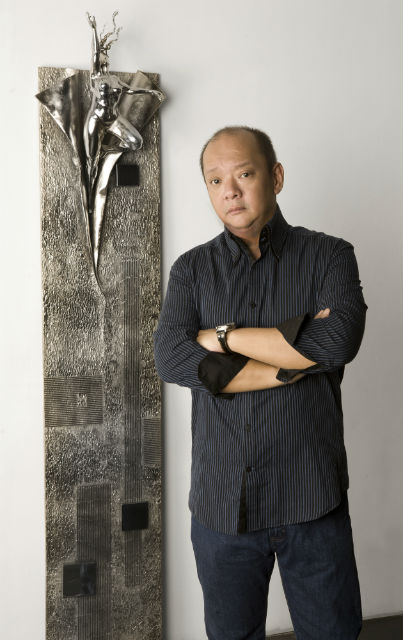
Daniel Dela Cruz once again proves his mettle with metal as he unveils his 10th one-man exhibit, entitled Doorway to Decision.


In his biggest and most experimental exhibit to date, Daniel explores spiritual crossroads, revealing very moving pieces that demonstrate tension as well as balance. “Everyone of us comes to a point when we have to take a stand, make a decision. Do we flee or do we fight? Each act we make has a consequence and how we deal with these consequences — Do we regret it? Do we embrace it? — intrigues me. Each piece I’ve made explores that and I hope the narrative resonates with the audience,” he says. 

Armed with a degree in Philosophy from UP, Daniel tackles the human complexity intelligently and gracefully. But despite exploring such a serious subject, his pieces are by no means somber. 

The 35 whimsical pieces, made from obstinate metals such as brass, bronze, copper and nickel, defy gravity. They teeter on cliffs; balance delicately on steel cables; leap, float and dance as if weightless. If not for his thoughtful inclinations, Daniel’s delft hand in creating beautifully fluid and balanced forms will have you entranced.

Best known for his graceful feminine sculpture, Daniel takes flight from his previous collections and fleshes out more masculine pieces. “Sculpting men is definitely more challenging for me. When sculpting women, just as long as the curves are correct, just as long as it flows, it will look beautiful. On the other hand, with men, any mistake in proportion and muscle will make it look completely off. But I did it for this exhibit because I wanted to challenge myself,” he says.

In Doorway to Decision, Daniel introduces kinetic pieces like “Beyond Infinity,” which has Rubenesque ballerinas slowly pirouetting atop their pedestal, and “The Darkest Hour Is Just Before Dawn,” a functional, sundial-like piece lit with LED lights. As you browse the other unique pieces, you will notice that acid and rust also play a great role in his new exhibit as Daniel has taken to experimenting with the elements to bring out color, depth and character. “Each of my pieces can be displayed outside. Rain or shine, rust or rain… It is supposed to age and degrade. It adds character to the pieces.”

Daniel has come a long way since his first exhibit in Ayala Museum in 2007 and with a grateful heart he concludes, “ I’m thankful to Dr. Joven Cuanang (one of the most respected art collectors in the country) for inviting me to exhibit in Pinto Art Gallery. It is a great honor. I will continue to push myself as an artist, even if it’s just an inch, just to prove that there is more that I can do.” 
JUNE - 
First published in PeopleAsia Magazine


Saturday, January 19, 2013

Dr. Aivee Teo: Fat Stem Cell Repair Therapy


We have all heard the saying “Health is wealth.” But Dr. Jung Kwang Seup, former chairman of the Korean Aesthetic Surgery Association and board certified plastic surgeon in Brazil, adds his own twist — “But a pinch of fat can keep you forever young!”
It is an intriguing statement and Dr. Seup is only too excited to explain. At the recent launch of Fat Stem Cell Repair Therapy (FSCR) at the posh Fort clinic of Dr. Z and Dr. Aivee Teo, Seup shares the “hows” and “whys” an extra inch or two around the waist may just bring you one step closer to eternal youth. 
The Fat Stem Cell Repair Therapy, the newest anti-aging technology in the Philippines, promises a whole new, youthful you in just two hours.
The FSCR therapy comes at the heel of two recent revolutions, namely: the recognition of fat tissue as the most abundant source of stem cells in the body and the improved technique of isolating stem cells from fat. Surgeons can now harvest stem cells in abundance without the need of culturing them for weeks in expensive facilities and laboratories. In fact, the FSCR therapy offered at the Dr. Aivee Aguilar-Teo clinic is able to do stem cell extraction in a little under two hours.
The cutting-edge FSCR procedure entails extracting stubborn fat from the thighs and tummy via ultrasound fat aspiration and separating stem cells from the fat with the use of the FDA Super Stem Cell Extraction machine. Once separated from the fat, the pure stem cells are then injected back into the face, neck, breast, hands and other areas of the body to reverse the signs of aging. Stem cells correctly injected into the target areas can result in tighter skin, a glowing complexion, firmer breasts and a natural facelift. Stem cell therapy has also been used to improve joint pain, lower blood pressure and improve diabetes. After a few treatments, patients observe an immense improvement in their overall health.

The government has not considered stem cell therapy a public health issue, and it also plans to come up with therapy guidelines in the country. But the debate is more focused on the moral and ethical issues of culturing and extracting stem cells from human embryos and sheep, rather than their efficacy. (Many studies already confirm the anti-aging and rejuvenating potential of stem cells in therapy) Dr. Seup clarifies that in the FSCR therapy, only stem cells from one’s own fat is used, so he claims it is 100 percent safe. Plus, the fully automatic procedure has been fine-tuned for optimum efficacy, requiring less fat tissue, producing a higher yield of stem cells, and shortening the recovery time of the patient. The closed system of extracting fat and the immediate integration of stem cells back into the body also ensures that there is no contamination.
But why are stem cells so important and why do they hold the key to looking forever young? Dr. Aivee Aguilar-Teo explains the roles of stem cells in her blog: “Stem cells in simple terms are the basic cells, which are able to differentiate into more specialized cells for different organs. Think of the popular Lego toys that we have all played before. It comes in small little pieces and as we piece them together, they become a car, a plane or whatever you want it to become. It may be a bit simplistic to use that analogy, but it encapsulates what all methods of stem cell are doing. (In FSCR therapy), we are getting basic cells to replace cells in our body, which have been lost through years of wear and tear, pollution, unhealthy diet and the inevitable process of aging.
“If the cells are not replaced adequately (because of age, radiation, pollution, unhealthy food, genetics, etc.) the organ will start to fail and diseases occur. It is the same in beauty. As we age, our skin (the body’s largest organ) is unable to replace the cells adequately and so it loses its tightness and brightness and we start to look older and more droopy,” she continues. The FSCR therapy helps boost the rejuvenation process by injecting stem cells into the target areas.
Seup affirms, when it comes to combating age, it is not enough that one looks youthful on the outside. Rejuvenation should also work from within, at its most basic cellular level. And to the delight of all those interested in trying out FSCR, everyone has a little bit of fat that they are only too willing to dispose of.

For best results, consult your doctor. For inquiries, please call The Fort clinic at 403-3245 or 403-1982 and the Cebu clinic at 0932-877-2763.

Sunday, January 13, 2013


Kaoru Kikuchi: Pearl of the Orient


“I don’t like anything (to be) too perfect. There is beauty in imperfection.”
This seems odd coming from Kaoru Kikuchi, a breathtaking beauty from Japan who, in the Philippines, with her luminescent alabaster skin, long jet-black hair, slender limbs, and soft eyes can be deemed “physically perfect.” But she shyly and timidly rejects this idea and prefers to be called a simple girl in love with pearls.
Kaoru, who works also as an international model, abhors the idea of fake breasts, nose jobs, and injecting Botox---common practices in the fashion industry where she’s immersed---that is why she is drawn to the delicateness and genuineness of pearls. She channels this love for pearls in her pearl jewelry line, KOZO, which means “naughty child” in her native tongue.

“I like things natural and beautiful,” she explains. “Pearls are naturally occurring things. They are the result of unique conditions and no one can predict or control how they’ll turn out which adds beauty to them.”
Unlike the nicely-rounded pearls found in jewelry stores (the perfectly-rounded ones are considered most valuable), Kaoru uses baroque pearls. They are imperfect, irregular in shape, and come in a variety of colors; they comprise her KOZO collection, Frost.
Like the designer, the collection is simple and elegant. Lengths of precious Akoya seawater pearls (the most rare kind harvested deep in the sea of Ise) from Mie Prefecture, Japan, are painstakingly and lovingly hand-tied by her team of artisans in Japan.
When one glances over her pieces, the jewelry is simple enough. But upon closer inspection of the different components of the design, one appreciates the exceptional thought and time put into it. There is something very organic and humble about the design. Bare and polished, it is not pretentious. These lustrous strands of pearls can be worn wrapped around, layered, and linked in infinite combinations as bracelets, necklaces, and even belts.

“I was inspired to go into accessories and jewelry because I would often go into department stores in Hong Kong and Singapore and, in my head, would think, ‘That necklace would look better with that or they should remove this, etc…’ So instead of settling for expensive pieces that did not suit my tastes, I decided to create my own,” Kaoru explains. Four years later, she now pours her time into designing pieces not just for herself but for the other fashionable women who share the same KOZO lifestyle: women with a taste for the glamour. Aside from pearls, the KOZO line now includes lingerie and one-piece bikinis.
After establishing a strong presence in Southeast Asia, Kaoru has her eyes set on expanding the KOZO line in Europe and Australia, while strengthening KOZO’s presence in Hong Kong and Japan.
Draped in her pearls and ready to model them for this photoshoot, Kaoru concludes the interview with, “I believe in jewelery. I believe that it’s a good luck charm.”
And looking at the success of Kaoru’s KOZO line, we don’t doubt it one bit.

Words by Kristel Dacumos-Lagorza / Photography by Doc Marlon Pecjo / As published in Rappler.com