Showing posts with label art. Show all posts

Tuesday, April 21, 2015

Architect Carlos Arnaiz of CAZA: The Philosophy of Design


File:18 Capilla CCV.jpg

While others look at buildings as their creative visions made real, the charming and bookish architect Carlos Arnaiz – winner of two consecutive Progressive Architecture awards in 2008 and 2009 and the
AIANY building merit award in 2008 – looks at the landscape with a spatial view in mind.


Talking like an engrossed history teacher and looking more like an inspiring professor of Law
rather than your typical architect, 35-year-old Filipino-Colombian architect Carlos Arnaiz of
the Brooklyn-based architectural firm CAZA admits he came into architecture through a very
unusual route. While most architects he knew were artists and had explored their creative side
at a very early age, he on the other hand, was a Philosophy major who hadn’t even the slightest
skill at doodling.

“There’s a branch in philosophy that I got interested in (while in Williams College) called geography. It’s not like the geography we know where you have to know the capital of Afghanistan,” says this self-proclaimed geek. “The branch of philosophy (that I studied) is a discipline that emphasizes
space and spatiality as a way of finding solutions to complex problems.” Carlos likens the discipline to the centuries-old Chinese tradition of feng shui – but without the kooky mysticism. “There’s a whole Chinese tradition of thinking about the importance of space — the economics of space, how we live in space, how we hang things, whether we paint walls this way. (If you may notice) just the organization of your living room space has this emotional, mental and psychological impact on how you live. The fact that there’s such a long tradition is a testament to how space can impact us on a
personal human level. When you zoom out to the macro level, the way you organize and use space
on a wider plane will also have a big impact on the people.”

Though he found geography and philosophy intellectually satisfying (he graduated magna cum laude), he felt frustrated that all his ideas had no real tangibility. ”I was operating on  theoretical level. I was hungry for a tool, an instrument to make my ideas real in the world. And that’s how I stumbled into architecture. Architecture has an intellectual side to it, but it also has a very practical side to it. It has givens like materials, paint, wood, concrete, steel and glass.”

Excited by his newfound calling and direction, Carlos applied for a master’s degree at Harvard University’s Graduate School of Design where he met the Dean of the College of Design, Peter Rowe. Together, they collaborated on a number of consulting projects for the city of Barcelona and the Emilia-Romagna Region in Italy. There they were hired by both regions’ respective governments to develop a regional master plan to solve the city’s problems. In 2008, Carlos received the Wheelwright Prize from Harvard University for his work on the Urbanism of the Modern University in four Latin American cities: Mexico, Caracas, Bogotá and Sao Paolo.

After a short stint with several other architects and architecture firms like Office DA, Ruf, Field Operations and Stan Allen Architect in New York, Carlos established his own firm CAZA and has since been traveling the world, working on projects in the Philippines, Colombia, Costa Rica and Taiwan. He recently finished building a chapel, his gift to the Chosen Children Village (a foundation in Silang, Cavite) for physically and mentally challenged children.

File:10 Capilla CCV.jpg

“It’s a wonderful story,” shares Carlos. “In 1989, a couple – a Filipina (Maria Angeles ‘Lita’ Peypoch Fullerton) and her American husband – decided to adopt a child with a disability. They instantly fell in love with the child and so they adopted another one, and then another, and then the next thing
they knew they had 200 kids and had to get the house next door. It’s a whole community called the Chosen Children Village and we designed a very simple chapel for their growing family,” Carlos
beams proudly as he himself is a very proud father of two little boys – Lucas (three) and Tomas (six months) with wife Elizabeth Taylor (no relation to the iconic diva).

The chapel, built from humble concrete, is a breathtaking sight with ceilings that rise to a heavenly height. Playing with verticality and sunlight, Carlos used the concrete to shape columns and panels
that allowed natural ventilation and different lights to illumine the sacred space. “There’s skylight up above. There’s light coming through these little panels here. So when you’re inside, you’ll see
that there’s a real play of shadows and a filtering effect of light from all angles — diffuse light, accent light and direct light,” Carlos beams as he animatedly paints a picture of his chapel with his hands.

He would later win a Merit Award from the American Institute of Architects and Faith & Form Award for this particular project. One of his other most prized works was the widely acclaimed
High Line project in New York, which he worked on as designer and senior associate. And like the Chosen Children Village, he loved the project because it celebrated a great history.

In the 1920s, elevated steel railroad tracks were built in Manhattan to transport cargo from the northern tip of the New York borough to its southern tip. Thereafter, in the early 1960s the tracks were abandoned and left to rust, causing people to insist that it be torn down by the city because it was an eyesore. However, the clamor to save the community marker, headed by locals and celebrities like Meryl Streep and Robert de Niro who lived in the Tribeca area, led to the idea of rehabilitating the ruins… and thus the High Line design competition was born.

In 2002, Carlos, with a team of five, bested 30 other firms with their thoughtful design. “Basically, what it is is a park. It sounds simple but it’s spectacular when you go up there. You take these stairs and imagine you’re like flying up in the sky almost 30 feet above the street. You can see the water, you can see the mountains, you can see midtown, and you can see the high rises of Manhattan. Here families can have picnics; people sunbathe and watch the sunsets. It’s magnificent.” Not only was Carlos able to do an impressive revamp of the old railroad, he was also able to preserve a piece of the
community that could have been easily lost to history.

The aerial greenway crosses 20th Street in New York

Railway tracks with the walking path cross 20th Street

Though his style may not be obvious in all of his projects, rest assured that each project is meticulously planned and imprinted with Carlos’ thoughtful touch. “I always say that designing a home for someone is like tailoring a suit. It has to be perfectly made; fit to the shoulders and to the waist; and to the way the person moves. In order to build him a home, you really have to study that person’s life.”

In making a home, accommodating the client’s lifestyle is more important than the architect’s “vision” he says, contrary to the myth presented in Ayn Rand’s The Fountainhead. “In the novel, one
genius (Howard Roark) supposedly comes up with this concept that solves everything. The fact of the matter is, it’s not true. I say the myth is damaging because I think a lot of young architects study architecture with that dream and they kind of get disillusioned when they realize that architecture is
complicated. It involves a lot of negotiations. Not one idea ever solves everything and we should be humble enough to accept that good ideas can come from anyone on the team.

“And I think as creative people, we are constantly cannibalizing ideas from others. I think it’s impossible to be completely original. You’re always borrowing and quoting, acting and reacting whether you like something or not; even not liking something forces you to take a position.” Though Carlos may not believe in originality, he however believes in true collaboration. “I don’t mind having too many cooks. I’m flexible and I encourage feedback. I believe the perfect project would be when
architects, clients and engineers come together.”

Having said that, Carlos belts a hearty laugh, admitting that he doesn’t know how smoothly that
will work out when he’s to build his own dream house. “I think it would be a nightmare! It would
be the ultimate dream and it would be a true collaboration because my wife is also an architect.
But we would never finish. It would be a perpetual project. And I have no idea how it would look like. ”

But even if he did have a blueprint in mind, Carlos for now would not have the time to build it as this busy bee is currently developing a student center for the National Chiao Tung University in Taiwan, a house in Costa Rica, a master plan for a coastal resort in the Philippines together with the construction of a prototype house, a cluster of three high-rise housing condominiums in Manila and a new market for vegetable farmers outside Bogota, Colombia. He also manages to squeeze in time to teach a class called “Urban Design Theory” at Pratt Institute.

For Carlos, architecture is not merely adding another building to the already overcrowded landscape. Rather, it is a discipline of design. He studies every aspect of the project, figuring in the sentiments of his clients, studying how to respond to the history of the location and above all, planning how his space will beautifully and seamlessly fit in the whole scheme of the city.


Marina Cruz: Art & Soul


For award-winning visual artist and child adoption advocate Marina Cruz, the unearthing of her mother’s baptismal dress made her reflect on the meaning of having a family. Her reflections gave birth to her own deeply personal art.
It all started in 2001 while Marina, then a second year college student, was rummaging through her mother’s belongings and chanced upon her mother’s baptismal dress. “Imagining my mother as a child seemed so surreal. The dress made me ‘experience’ the childhood she once had. It gave me goose bumps,” shares the cum laude graduate from the University of the Philippines-College of Fine Arts.
It was a poignant moment for her because at the time of the discovery, her mother, Elisa, a primary public school teacher in Bulacan, was often sick. “The tattered dress simulated also my mother’s aging. I felt that I needed to preserve that memory. I realized the value of time, the value of life. You really have to savor every moment with your loved ones because you can never go back.” Since 2001, her art — from the embroidered mementos and mixed-media paintings to her famous “fossilized” baby doll dresses — has followed that same thread of nostalgia and appreciation for family.
In the past decade, Marina has held 14 solo exhibitions in the Philippines, Taiwan, China, Australia and Singapore and has garnered praise from prestigious art groups including the Philippine Art Awards where she won grand prize in 2007. She’s also the recipient of the Ateneo Art Award in 2008, which included a fellowship at La Trobe University’s Visual Art Center, Australia. Later that year, she was awarded with the Freeman Fellowship at Vermont Studio Center, Vermont.
Over time, and through much reflection, the concept and definition of family grew to be an essential part of Marina’s art. As a happily married woman, she hoped that she and her husband, fellow artist Rodel Tapaya, would be able to start their own brood soon. But unfortunately, the couple had difficulty conceiving due to Marina’s polycystic ovary syndrome.
“As artists, our creativity comes natural to us. But when it came to procreation, creating a child, starting a family, it wasn’t as easy,” Marina shares during her TEDx talk at her alma mater, University of the Philippines-Diliman. But like a true artist, she was open to God’s inspiration and creativity.

With her husband’s urging, they decided to adopt. And two months after submitting their requirements to the Department of Social Welfare and Development, the couple was matched with an 11-month-old baby boy, whom they named Yohan, meaning “Gift of God.”
With a precocious toddler now in their life, their world was turned upside down, so much so that Marina did not notice that she was pregnant a month later with Keon.
“People expected me to have twins; my mother had a twin. They were right,” she chuckles. “Just not biological.” Today, as an advocate of domestic adoption, Marina travels the country sharing her own story, and her art helps in spreading her message. “This is very fulfilling for me, to be able to share my art and advocacy, because I was able to discover a new, beautiful way to form families. Family is not defined by biology alone, but love.”

First published in The Philippine STAR, Allure Section
Photography by RITA MARIE ABIOG • Creative direction by LUIS ESPIRITU JR. • Styling by DIANE LASAM • Makeup by SARI CAMPOS • Hairstyling by RHOY CERVANTES • Jewelry by MILADAY JEWELS • Shot on location at  SOLAIRE RESORT & CASINO’s YAKUMI

Madrid Fusion Manila: A World of Food and Flavor Come to Manila

An explosion of bold flavors, exotic ingredients and mouthwatering aromas from the country’s most famed Filipino-Spanish dishes are set to tickle the palate in the most, exciting way – as the main attraction of the first local edition of Madrid Fusion.


For more than 12 years, Madrid Fusion has been the most important international gastronomic event on progressive haute cuisine in Spain. And for the first time in history, it will be held outside Madrid –in no other place than our humble home, The Philippines.

As a significant culinary destination and a well-known melting pot of diverse cultures, the Philippines has proudly nurtured its own culinary traditions, born from its own rich heritage, which takes influences from China, Malay and most especially Spain, with whom we have shared more than 300 years of close ties.   

As the banner project of the “Visit the Philippines” campaign of the Department of Tourism, Madrid Fusion Manila trains the spotlight on the Philippines as an Asian Center of Gastronomy, and aims to promote the country as a top culinary destination for 2015. With Ayala Malls as its partner and official events center, Madrid Fusion Manila brings together an exceptional showcase of music, film, and, of course, the best Filipino-Spanish fare this country has to offer.  


Celebrate food!
Filipino-Spanish fare is brought to new epicurean heights as Ayala Malls celebrates gastronomy through an exciting array of activities, including Menu Degustacio (tasting menus), Cocinas Viajeras  (travelling food trucks), and the Comidas Preferidas (Ayala Mall’s Food Choices buffet trail).


Held April 10 to 26, in select fine dining restaurants of participating Ayala Malls, the Menu Degustacio will give culinary connoisseurs the unique opportunity to feast on specialty dishes that imbibe Madrid Fusion’s spirit of culinary innovation, techniques, and deconstruction. Savor the exquisite flavours of classic dishes, as well as new, mouth-watering culinary creations crafted by the country’s renowned chefs.

Cocinas Viajeras, on the other hand, brings the Spanish-themed dishes to the people, through stylized food trucks and kitchen demos hosted by celebrity chefs, including Chef Gaita Fores, Chef Sau del Rosario and Chef Rob Pengson. Catch the Cocinas Viajeras as they tour Bonifacio Highstreet and Trinoma (April 10-12), Glorietta (April 17-19) and Alabang Town Center (April 24-26).

Adding on to the fun-filled food-centric activities, the Comidas Preferidas (Food Choices buffet trail) will bring the Madrid Fusion Manila experience to the everyday food lover by offering sumptuous merienda at an unbeatable price. The delectable dishes will be served at all merchants of Ayala Malls’ Food Choices on April 13-16 and April 20-23, from 2 p.m. to 5 p.m.  Relish all the dishes that have been meticulously prepared and seasoned with love.

Fiesta! Food & Music Festival
Food is not simply about satiating appetite, it’s an all sensory experience that excites and inspires. So to truly embrace the essence of Madrid Fusion Manila, Ayala Malls has also cooked up Fiesta!, a food and musical festival that blends the fascinating worlds of gastronomy and music.

Delight in the Festival de la Paella Gigante III at Greebelt 3 Park, where you can partake of giant paella prepared by Chef J Gamboa, Chef Fernando Aracama, Chef Carlo Miguel and Chef Mikkel Arriet on April 18.


Pelikula: Spanish Food Film Festival
Aside from offering a sumptuous feast that fills the tummy, Madrid Fusion Manila will serve up a visual feast with films that center on the art of gastronomy. Ayala Malls, the Embassy of Spain and Instituto Cervantes will kick off the film festival on April 21, 6 p.m. at Greenbelt 5, with the special screening of Mugartiz B.S.O. Catch the slew of other notable films, including 3055 Jean Leon, El Somni del Celler de Can Roca, and Taba. Table Game Nerua Guggenheim Bilbao, which will run until April 26. Tickets are priced at P100 per screening.

Bringing more films to excited audiences, Centrio Mall will host a Spanish Food Film Festival in partnership with Xavier University on April 17, 10 a.m. to 2p.m., and Bonifacio High Street will also screen select movies on April 11 at its activity center.

For your convenience, you can enjoy all of Madrid Fusion Manila’s great gustations and more with the new BPI-Ayala Malls Amore VISA prepaid debit card. Avail of the 20% discount on all Madrid Fusion Manila at Ayala Malls specialty dishes, film screenings, and other activities. Plus, get the chance to win a trip to Madrid. VISA Cardholders can double their chances of winning with every purchase.

Sunday, March 22, 2015

4000 Miles: Love in Between

The award-winning play,4000 miles, covers the distance between two hearts, that of Leo Joseph-Connell (played by Jef Flores) and his grandmother Vera Joseph (Baby Barredo) .

Theater veteran Baby Barredo as Vera and Jef Flores as Leo in Repertory Philippines' adaptation of '4, 000 Miles.' Photo courtesy of Repertory Philippines.

After his bestfriend dies due to a violent accident, while on a cross-coutry bike trip, Leo pays a short visit to his elderly grandmother at a West Village apartment to seek solace. Over time, their differing personalities and the generational gap becomes apparent, leading to sometimes painful, other times, funny encounters.However, no matter how often they may butt heads, their sincere affections for each other help them maneuver through the sometimes difficult circumstances.

“This is really about someone who is at that point in her life when her body has given up on her and all that she is at this point is a fountain of wisdom. At the other end of the spectrum is a man who is about to begin his life, who is lost in so many ways. Between them, there are 4000 miles of experience and wisdom,” director for the play Bart Guingona shared in a press statement.

First staged Off-Broadway in 2011, the critically acclaimed play was a finalist for the 2013 Pulitzer Prize for Drama and named the Best New Play by the Obie Awards in 2012. New York Times had also hailed Herzog an outstanding playwright.

Review...

The play carries itself with quiet confidence, able to deliver a heartfelt story laden with sincerity and wisdom without resorting to an overly heavy and dramatic dialogue. Thanks to Amy Herzog's writing genius, the nuances of each character and their honest interactions make for a truly touching story that every one must watch. And for anything else, Baby Barredo is just simply charming- a true light of talent that not only fittingly trains the spotlight on her own prowess as a theater actor, but allows for her fellow actors to shine onstage as well.

The play, 4000 miles, will run at Greenbelt Mall 1 until March 29. Prices start at P400. for more information , call Reportory Philippines at (63) 843 3570 or TicketWorld at (63) 891 9999

4000 Miles will run until March 29 at Onstage Theatre, Greenbelt Mall 1. Ticket prices range from Php400 to Php600. For more information, call Repertory Philippines at (+632) 843-3570 or Ticketworld at (+632) 891-9999.

Wednesday, August 13, 2014

Alexander Charriol: Human Flow IV


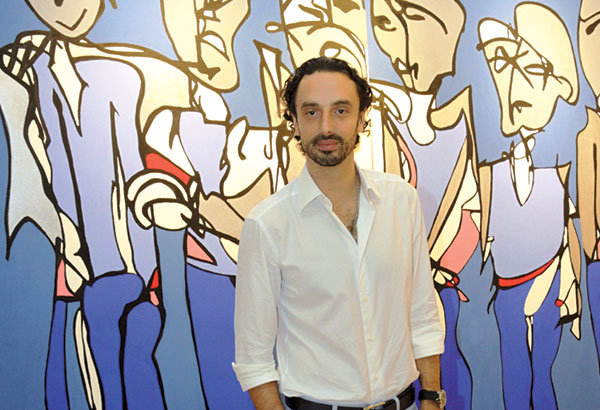
French-American artist Alexander Charriol’s work may be “autobiographical, but it is overwhelmingly universal–a visual poem that tackles the entangled nature of who we are.”

From the somber silhouettes that huddle together in the Tin Man Party to the prying eyes that gloss over the provocative woman in Stop the Madness, the figures in each of Charriol’s canvases tell the many stories of the human experience: love, loneliness, selfishness, greed, discontent, as well as the need for human connectedness.

Tin Man Party

Charriol’s creative journey began in 2010 when the graduate of Parsons School of Design decided to move from New York to settle, almost like a hermit, in the hills of Los Angeles. There, in isolation, he picked up the brush and started painting. “I was very lonely, I lost my friends, I lost everything,” reveals the 34-year-old, who admits to also having fallen weak to drug abuse at that time, thus the self-imposed isolation. “I was in a house with a beautiful view but no one around, so I got very lonely and then so I started painting a lot of people.”

With every stroke and brandish of color, Charriol allowed the “flow of feeling and energy” to grow stronger and fill the space that had been left empty. The therapeutic exercise turned into a creative one, and eventually led to an epiphany: “Humans need touch. People need to be together. Without touch, without being together, humans are not gonna survive,” explains Charriol.

STOP THE MADNESS
Stop the Madness

This Human Flow concept permeated his work and persisted well into the creation of his fourth installment in the series, which was exhibited recently at the Altro Mondo Arte Contemporanea, Greenbelt 5, Makati City. 

Excited for the newest collection, admirers and fellow artists like National Artist Arturo Luz, Betsy Westendorp, glass sculptor Ramon Orlina, former CCP president Nestor Jardin, Ballet Philippines president Margie Moran Floriendo and Lane Moving’s Virginia Lane dropped by to show support for their artist-friend.


“Painting can be therapeutic at times when things are going great,” says Charriol. “But once when you don’t know where you’re heading, anxiety starts to fill yourself. No one’s telling you what to draw, what to do, so you really have to stay focused and believe in what you’re doing,” he reveals, adding that when his motivation is lagging, he retreats to his studios in New York and Bangkok. (Especially in Bangkok, where his studio nestles on the bank of the river, Charriol finds that he never runs out of inspiration.) 

Looking around the well-curated space of Altro Mondo, with the massive canvases embracing entire walls, Charriol beams proudly at his work. “It’s good to hear honest feedback. It’s a good feeling to get your art work out of the studio and onto the walls.” And perhaps also, he has realized it’s good to allow others to see themselves in the pictures. We are, after all, connected. His story is their story.


Tuesday, June 18, 2013

Daniel dela Cruz: Doorway to Decision


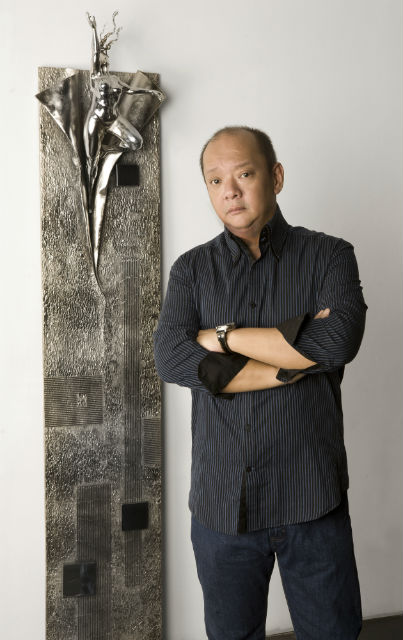
Daniel Dela Cruz once again proves his mettle with metal as he unveils his 10th one-man exhibit, entitled Doorway to Decision.


In his biggest and most experimental exhibit to date, Daniel explores spiritual crossroads, revealing very moving pieces that demonstrate tension as well as balance. “Everyone of us comes to a point when we have to take a stand, make a decision. Do we flee or do we fight? Each act we make has a consequence and how we deal with these consequences — Do we regret it? Do we embrace it? — intrigues me. Each piece I’ve made explores that and I hope the narrative resonates with the audience,” he says. 

Armed with a degree in Philosophy from UP, Daniel tackles the human complexity intelligently and gracefully. But despite exploring such a serious subject, his pieces are by no means somber. 

The 35 whimsical pieces, made from obstinate metals such as brass, bronze, copper and nickel, defy gravity. They teeter on cliffs; balance delicately on steel cables; leap, float and dance as if weightless. If not for his thoughtful inclinations, Daniel’s delft hand in creating beautifully fluid and balanced forms will have you entranced.

Best known for his graceful feminine sculpture, Daniel takes flight from his previous collections and fleshes out more masculine pieces. “Sculpting men is definitely more challenging for me. When sculpting women, just as long as the curves are correct, just as long as it flows, it will look beautiful. On the other hand, with men, any mistake in proportion and muscle will make it look completely off. But I did it for this exhibit because I wanted to challenge myself,” he says.

In Doorway to Decision, Daniel introduces kinetic pieces like “Beyond Infinity,” which has Rubenesque ballerinas slowly pirouetting atop their pedestal, and “The Darkest Hour Is Just Before Dawn,” a functional, sundial-like piece lit with LED lights. As you browse the other unique pieces, you will notice that acid and rust also play a great role in his new exhibit as Daniel has taken to experimenting with the elements to bring out color, depth and character. “Each of my pieces can be displayed outside. Rain or shine, rust or rain… It is supposed to age and degrade. It adds character to the pieces.”

Daniel has come a long way since his first exhibit in Ayala Museum in 2007 and with a grateful heart he concludes, “ I’m thankful to Dr. Joven Cuanang (one of the most respected art collectors in the country) for inviting me to exhibit in Pinto Art Gallery. It is a great honor. I will continue to push myself as an artist, even if it’s just an inch, just to prove that there is more that I can do.” 
JUNE - 
First published in PeopleAsia Magazine